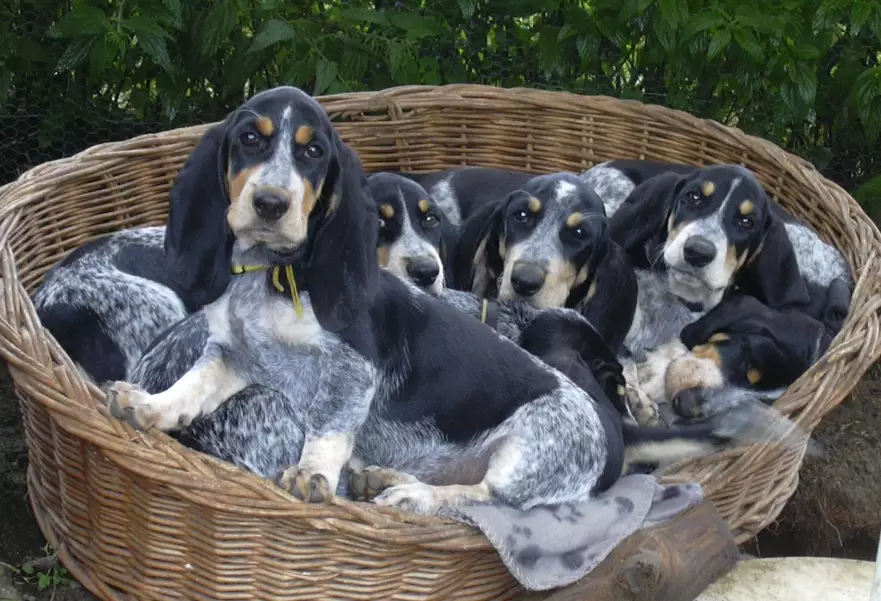
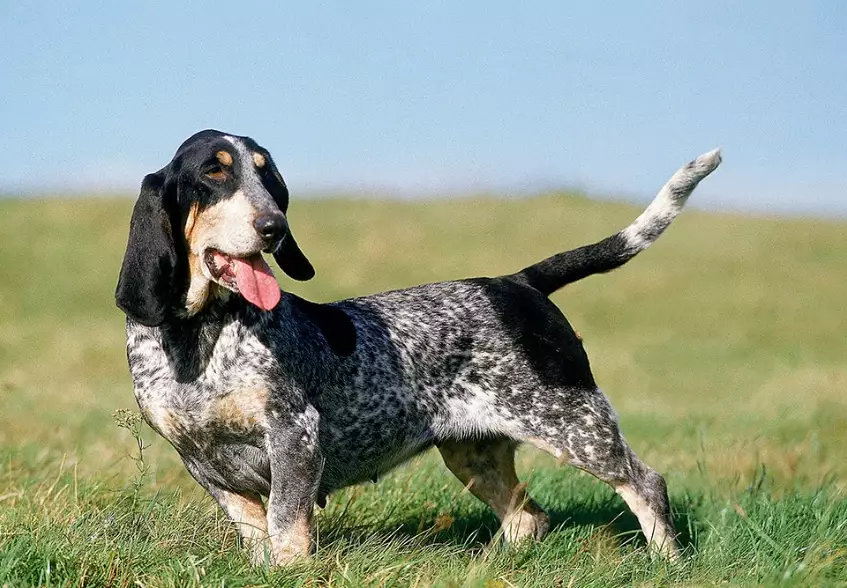
If you've stumbled upon a photo of a low-slung, droopy-eared hound with a mesmerizing blue-mottled coat and soulful eyes, you've likely met the Basset Bleu de Gascogne. More than just a pretty face with a fancy French name, this dog is a living piece of history, a dedicated working hound, and a surprisingly affectionate family companion wrapped into one unique package. They're not your everyday sight, which is precisely why understanding what they truly are—beyond the basic breed description—is crucial before you fall head over heels. To know the Basset Bleu de Gascogne is to know the Gascony region of southwestern France. This area is famous for producing exceptional scent hounds, and the "Bleu" is one of its masterpieces. They descended from the much larger Grand Bleu de Gascogne, selectively bred down in size ("basset" means "low" in French) to create a slower-moving hound that hunters on foot could follow through thick underbrush for game like hare and rabbit. Their history isn't just old; it's storied. Many believe their lineage traces back to hounds brought to Gaul by Phoenician traders and refined by monks at the Abbey of Saint Hubert. They survived near-extinction after World War I, saved by dedicated breed enthusiasts. This isn't a breed cooked up in a modern kennel for looks. Every droopy ear and deep chest was forged for a purpose. The Fédération Cynologique Internationale (FCI) and the United Kennel Club (UKC) both recognize the breed, with the UKC providing a detailed Basset Bleu de Gascogne breed standard that outlines their ideal form and function. You can't miss them. A Basset Bleu is a study in elegant, functional proportions. Forget the exaggerated, cartoonish shortness of some bassets. The Bleu is balanced. Don't expect a sky-blue dog. The "blue" is a specific genetic ticking pattern where black and white hairs mix closely, giving a slate grey or blue-grey appearance from a distance. It's a hallmark of the Gascony hounds. When puppies are born, the ticking isn't fully developed; it comes in as they grow. If you see a heavily solid black-and-white Basset Bleu, it's not meeting the classic standard. This is where the breed truly shines—and where many first-time hound owners get surprised. They are not lazy couch dwellers by default. Their temperament is a fascinating blend of opposites. The Nose Leads: First and foremost, they are scent hounds. Their world is defined by smell. On a walk, if an interesting trail crosses their path, their brain seems to switch off to everything else—including your recall command. This isn't disobedience in the moment; it's centuries of breeding screaming louder than your treat pouch. You don't own a Basset Bleu; you manage a partnership with a nose on four legs. Gentle and Affectionate: At home, with their "pack," they are remarkably sweet, calm, and devoted. They form strong bonds and often shadow their favorite person from room to room. They are generally excellent with children, displaying a patient and tolerant nature. I've seen them gently take treats from toddlers with more care than some retrievers. Vocal: Here's the big one. They have a beautiful, deep, melodious bay. They use it to communicate excitement, alert you to a squirrel in the yard, or express boredom. It's a sound that carries. If you live in an apartment with thin walls or have grumpy neighbors, this is a deal-breaker. It's not constant barking, but it is a powerful, purposeful voice. Stubborn or Independent? People call them stubborn. I find that unfair. They are problem-solvers with a strong independent streak. If lying in the sun is more appealing than coming inside, they'll weigh their options. This requires persuasive, positive training, not brute force. Their short coat is low-maintenance. A weekly brush with a rubber grooming mitt or hound glove removes dead hair and distributes skin oils. They are moderate shedders. The real grooming focus areas are their ears and wrinkles. Those long, floppy ears trap moisture and can become infected if not checked and cleaned weekly with a vet-approved ear cleaner. The slight wrinkles on the face should be kept dry and clean to prevent dermatitis. A common mistake is thinking their short legs equal low exercise needs. Wrong. A bored Basset Bleu is a destructive, vocal Basset Bleu. They need 45-60 minutes of activity daily. This shouldn't be just a leash walk around the block. They thrive on sniffari walks where they can explore scents. Mental exercise is even more critical: nose work games, food puzzles, and short training sessions tire them out beautifully. A securely fenced yard is non-negotiable for safe off-leash exploration. This breed loves food and can easily become overweight, which puts immense strain on their long back and joints. Measure their food, limit high-calorie treats, and avoid free-feeding. A high-quality diet formulated for medium-sized, less active breeds is a good start, but consult your vet. Generally a robust breed, but like all purebreds, they have predispositions. Reputable breeders test for these. A responsible breeder will provide Orthopedic Foundation for Animals (OFA) or similar clearances for hips, elbows, and sometimes eyes. Ask to see them. Let's be brutally honest. They are NOT for everyone. Choose a Basset Bleu if: You have a secure, fenced yard. You appreciate deep, vocal communication. You want a loyal, gentle family dog. You enjoy scent-based games and mental stimulation. You are patient and use positive reinforcement training. You don't need a flawless off-leash recall in an open field. Think twice if: You need a quiet dog. You live in an apartment without sound tolerance. You want a dog that will instantly obey every command. You are away from home for 8+ hours regularly. You get frustrated by independent thinking. Because they are rare, finding one requires patience and diligence. Avoid puppy mills and online brokers at all costs. Training a Basset Bleu is an exercise in mutual respect. They are sensitive and do not respond to harshness. My number one tip: Make yourself more interesting than the environment. Use high-value treats (cheese, boiled chicken), keep sessions short (5-10 minutes), and end on a positive note. Socialization is non-negotiable. From 8-16 weeks, expose your puppy positively to every sight, sound, and surface you can imagine: different people, vacuum cleaners, cars, grates, other friendly dogs. A well-socialized Bleu is a confident, adaptable adult. A poorly socialized one can become fearful or reactive—and a fearful hound with a big voice is a challenge. The recall is your holy grail and your greatest challenge. Start in a boring, enclosed space. Use a long line (30 ft leash) in real-world practice to prevent them from learning they can ignore you. Never scold them when they finally come back, even if it took 10 minutes. You want coming to you to always be the best thing that happens.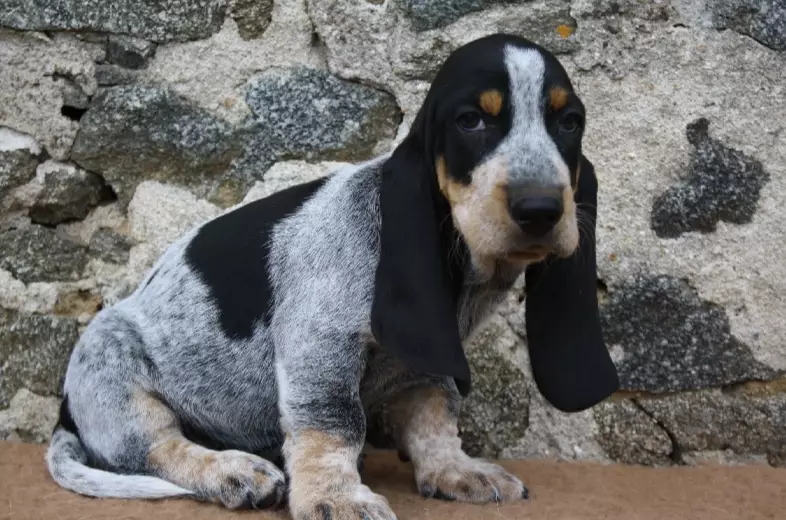
Your Quick Guide to the Basset Bleu
Where Did This Blue Hound Come From?
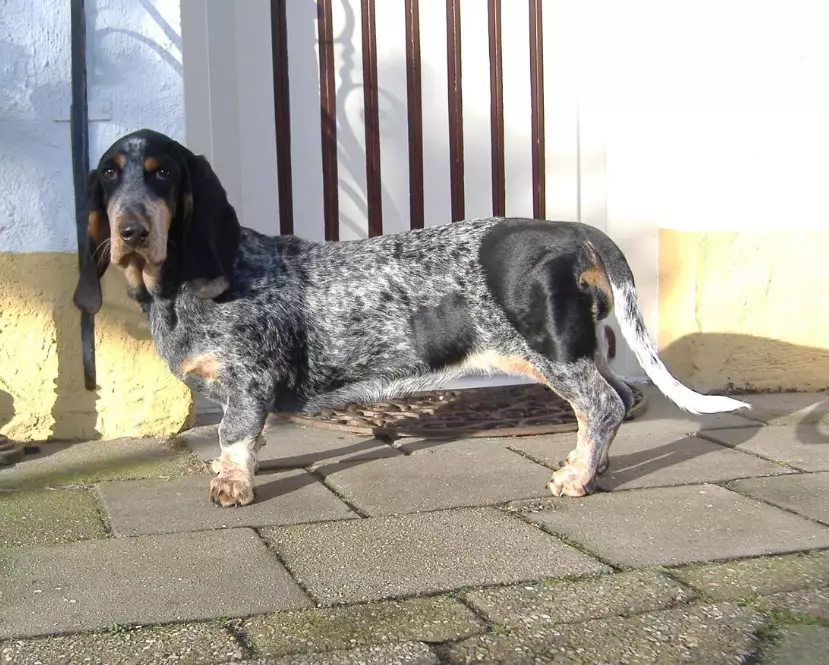
The Basset Bleu Look: More Than Just Spots
Feature
Description
Why It Matters
Coat & Color
Short, dense, and smooth. The base is pure white with black patches that create a "blue" (charcoal) ticking or mottling. Classic tan markings above the eyes, on cheeks, ears, legs, and under the tail.
The ticking provides camouflage in dappled forest light. The smooth coat is easy to maintain but offers little insulation against cold or wet.
Build
Long, muscular body with a deep chest. Legs are short but strong, with a slight bend. They are substantial, not delicate.
The deep chest houses large lungs for endurance. The short, sturdy legs allow for steady, ground-covering movement over long periods, not speed.
Head & Expression
Noble, slightly domed skull. Long, velvety ears that curl inwards at the tip. Dark brown eyes with a gentle, pleading expression.
The long ears help sweep scent particles toward the nose. The expression is a hallmark of the breed—soulful and intelligent.
Size
Height: 13-15 inches at the shoulder. Weight: 35-45 pounds.
Compact enough for apartment life, but heavy enough that you might think twice about letting them sleep on your lap for hours.
A Note on That "Blue" Coat
Inside the Basset Bleu Mind: Personality & Temperament
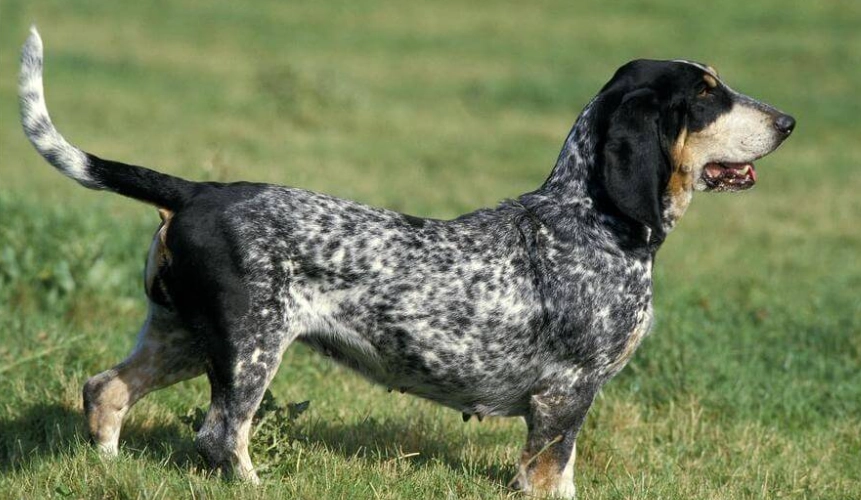
Caring for Your Basset Bleu: A Realistic Guide
Grooming: Easier Than You Think
Exercise: It's About Mental Fatigue
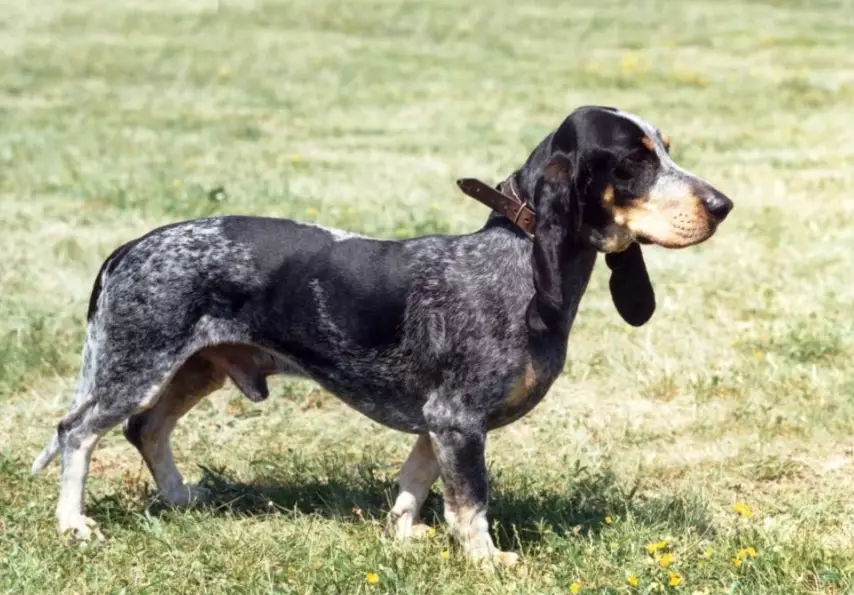
Diet: Watch the Weight
Health Considerations: What to Watch For
Is a Basset Bleu de Gascogne Right For You?
How to Find a Basset Bleu de Gascogne Puppy
Training & Socialization: The Expert's Approach
Your Basset Bleu Questions Answered
 So, what is a Basset Bleu de Gascogne? It's a loyal, gentle friend with a magnificent nose and a voice to match. It's a dog that will make you laugh with its antics, sigh at its stubbornness, and feel utterly loved by its devotion. It's a commitment to understanding a different kind of canine intelligence—one guided by scent and centuries of purpose. If your lifestyle aligns with their needs, a Basset Bleu offers a companionship filled with unique charm and deep, resonant personality.
Are Basset Bleu de Gascognes good apartment dogs?
They can adapt surprisingly well to apartment life due to their moderate size and generally calm indoor demeanor. However, two major caveats apply. First, their loud, carrying bay can easily disturb neighbors in close quarters. Second, you must be hyper-committed to providing their daily mental and physical exercise needs without a yard to fall back on. If you can manage the noise and the activity requirement, it's possible, but a ground-floor unit with easy access is ideal.
Is a Basset Bleu de Gascogne good with cats?
It heavily depends on the individual dog and the introduction. Their strong prey drive is tuned to small, furry animals that run. A resident cat that stands its ground may be respected, especially if the puppy is raised with it. A strange cat darting across the yard will almost certainly trigger their chase instinct. Never leave them unsupervised with small pets, and always introduce with extreme care, using baby gates and controlled settings.
How much do Basset Bleu de Gascogne puppies cost?
From a reputable, health-testing breeder, expect to pay between $1,800 and $3,000. The price reflects the rarity of the breed, the cost of health screenings for the parents, and the significant investment responsible breeders make in raising their litters properly. Puppies advertised for significantly less are a major red flag and likely come from a backyard breeder or mill.
Do Basset Bleus drool a lot?
They are not extreme droolers like some mastiffs or Saint Bernards. However, you will get some drool—especially after drinking water (those long ears often dip into the bowl and then fling water everywhere) or in anticipation of food. Keeping a "slobber towel" handy by the water bowl is a standard practice among owners.
What's the biggest mistake new Basset Bleu owners make?
Underestimating their need for mental stimulation and secure containment. People see a short-legged dog and think "couch potato." They then get frustrated when the dog becomes destructive or incessantly vocal out of boredom. Similarly, trusting their recall in an unfenced area is the fastest way to lose your dog. That nose will always win against even the best training in an open, scent-rich environment. A physical fence is a requirement, not a suggestion.
Comment