So you're thinking about a Manchester Terrier, or maybe you've already got one curled up at your feet. One of the first things everyone wants to know is, how big do these dogs get? It seems simple, but the Manchester Terrier size question has more layers than you might think. Is it a tiny apartment dog or a mid-sized athlete? The answer, famously, is both. I remember when I first started looking into the breed. I'd see pictures of a sleek, leggy dog and then another that looked like a miniature version. I was totally confused. Were they the same dog? Turns out, the breed comes in two distinct packages, and knowing the difference is crucial. It's not just about aesthetics; it impacts their exercise needs, their suitability for your living space, and even their potential health considerations. Let's cut through the confusion. This guide isn't just a list of numbers. We're going to dig into what those numbers mean for living with a Manchester Terrier, how to tell if your dog is the right size, and what to do if you suspect something's off. This is the big one. The American Kennel Club (AKC) and other major kennel clubs like The Kennel Club (UK) recognize two varieties based solely on weight. They're the same breed in personality and most looks, but their Manchester Terrier size puts them in different categories. Some people call them "Toy" and "Standard," which is helpful shorthand, but the official breed standard just gives weight ranges. Here’s the breakdown in the clearest way I can put it: See the gap? A 22-pound Standard is nearly double the weight of a 12-pound Toy. That's a significant difference in physical presence. The Standard has more bone and muscle, built for endurance and speed (they were originally ratters, after all). The Toy is a refined, compact version. Honestly, some breeders I've spoken to wish the weight divide was a bit clearer in the middle. You occasionally get a Toy that's a robust 11.5 pounds and a Standard that's a leggy 13 pounds, and they can look surprisingly similar. The bone structure is the real giveaway. Focusing only on weight or height is a mistake. A healthy Manchester Terrier size is about proportion and condition. The breed standard calls for a sleek, muscular build—never chunky or coarse. You should be able to easily feel your Manchester's ribs with a slight layer of fat over them. From above, you should see a visible waist behind the ribs. From the side, the abdomen should tuck up. If your dog looks like a sleek sausage or, on the other end, you can see every rib and vertebra, the weight is off. I learned this the hard way with a friend's Manchester. They were feeding him "just a bit" of people food, and he slowly became... portly. He was still within the weight range for a Standard, but he'd lost that distinctive, elegant silhouette. He got tired faster on walks, too. It took a disciplined diet to get his athletic figure back. How fast do they grow? Manchester Terriers are relatively quick to mature in terms of skeletal growth, but they fill out muscle-wise over a longer period. Most of their height is achieved by 6-8 months. They'll look all legs and ears for a while—a phase I find both awkward and endearing. They reach their adult weight usually between 9-12 months, but this is just the skeleton settling. A one-year-old Manchester often still has a "puppyish" look, not yet possessing the full, mature musculature. The real transformation happens between 1 and 2 years old. This is when they put on muscle, their chest deepens, and they attain that final, polished Manchester Terrier size and shape. A well-exercised two-year-old is a picture of canine athleticism. Here's a rough, non-scientific growth chart based on observations and breeder notes. Remember, individual dogs vary! Why is your neighbor's Standard 18 pounds and yours 21? A few factors are at play. Genetics are the biggest driver. The size of the sire and dam is your best indicator. Reputable breeders carefully select for dogs that fit the standard. If both parents are small Standards, the puppies likely will be too. The gene for the Toy variety is dominant, so breeding a Toy to a Standard will usually result in Toy-sized puppies. Nutrition plays a massive role, but not in the way you might think. Overfeeding doesn't create a larger-boned dog; it creates an overweight one. Underfeeding during critical growth phases can stunt development. A balanced, high-quality diet suitable for a puppy's (or adult's) energy needs is what lets them reach their genetic potential. Sex makes a slight difference. Males are often, but not always, slightly larger and more substantial in build than females. The difference is usually only a pound or two and an inch in height. And then there's just plain old individual variation. Even in the same litter, you can have a range of Manchester Terrier sizes. Size isn't just about looks; it's linked to health. This is where the EEAT (Experience, Expertise, Authoritativeness, Trustworthiness) of information really matters. For the Toy Manchester Terrier, their small size and fine bones make them more susceptible to injury from jumps or rough handling. They can be more sensitive to cold due to less body mass. Patellar luxation (slipping kneecaps) is a condition seen in many toy breeds, and responsible breeders screen for it. Dental issues are also more common because their tiny mouths can lead to overcrowding. The Standard Manchester Terrier, being more robust, generally avoids the fragility concerns of the Toy. However, no dog is free from potential issues. Their athletic nature means they can be prone to muscle strains if not warmed up properly. As with all deep-chested breeds, there is a very low risk of bloat (GDV), though it's less common than in giant breeds. Maintaining a lean weight is critical for joint health throughout their life. The single best thing you can do for any Manchester's health, regardless of size, is to source your dog from a breeder who does the recommended health testing. The American Kennel Club's breed page and the Manchester Terrier Club of America website are authoritative resources that list health concerns and can guide you to ethical breeders who prioritize health over just hitting a specific Manchester Terrier size. Want to track your dog's growth or just satisfy your curiosity? Here's how to do it right. For weight: Use a digital scale. For Toys, a simple baby scale works perfectly. For Standards, you can weigh yourself, then weigh yourself holding your dog, and subtract. Do this monthly for puppies, every few months for adults. For height (at the withers): This is the highest point of the shoulder blades. Have your dog stand square on a level surface. Use a carpenter's level or a book placed flat across the withers, touching the wall. Mark the spot below the level/book and measure from the floor to the mark. Keep a little log. It's fun to look back on, and it provides concrete data for your vet if you ever have growth concerns. I've gotten a lot of questions over the years. Here are the most common ones, boiled down. Really, the energy level and temperament are nearly identical. The choice often comes down to your preference in physical feel and lifestyle logistics (e.g., ease of travel with a Toy). Understanding Manchester Terrier size is about embracing a duality. This is a breed that offers a choice. Do you want a compact, portable companion or a leggy, small-scale athlete? Both will give you the same fierce intelligence, loyalty, and sleek black-and-tan beauty. The numbers—the 12-pound dividing line, the 15-16 inch height—are important starting points. But the true measure of a Manchester Terrier is in its elegant proportion, its springy muscle, and its alert presence. Whether your dog fits in the crook of your arm or trots confidently beside you on a hike, if it's healthy, lean, and full of life, then it's the right size. Focus less on hitting an exact number on the scale and more on maintaining that iconic silhouette through proper diet and exercise. That's how you ensure your Manchester lives a long, agile, and happy life, perfectly sized for your heart.Key Insights
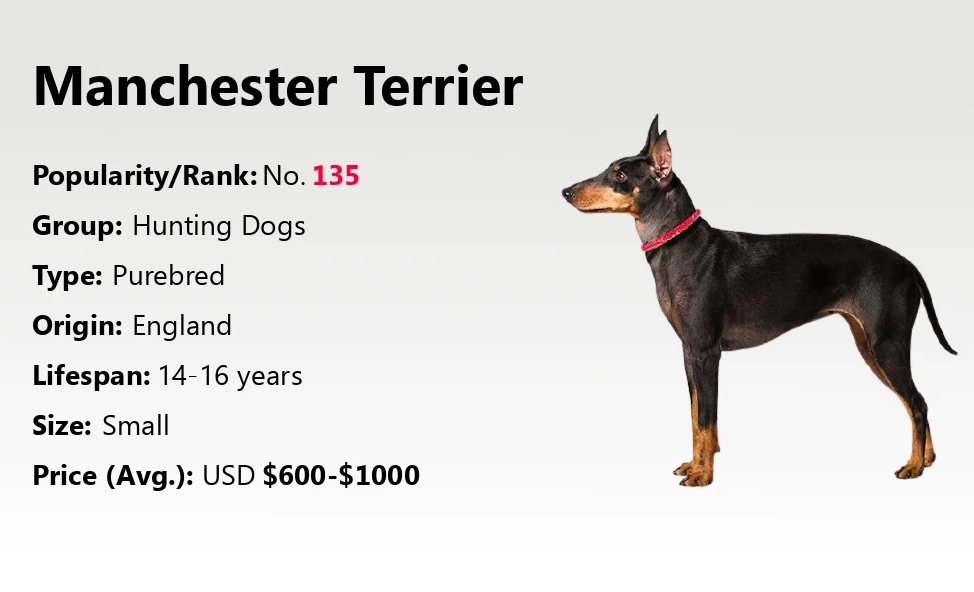
The Two Sizes of Manchester Terrier: It's Not Just Height
Variety Official Weight Range Typical Height at the Shoulder The "Feel" of Their Size Toy Manchester Terrier Under 12 pounds (usually 7-12 lbs) 10-12 inches True toy breed. Fits on your lap, in a carrier with ease. Fine-boned and delicate. Standard Manchester Terrier Over 12 pounds, up to 22 pounds (commonly 15-22 lbs) 15-16 inches Small but substantial. Athletic, muscular, and leggy. More "small dog" than "toy." 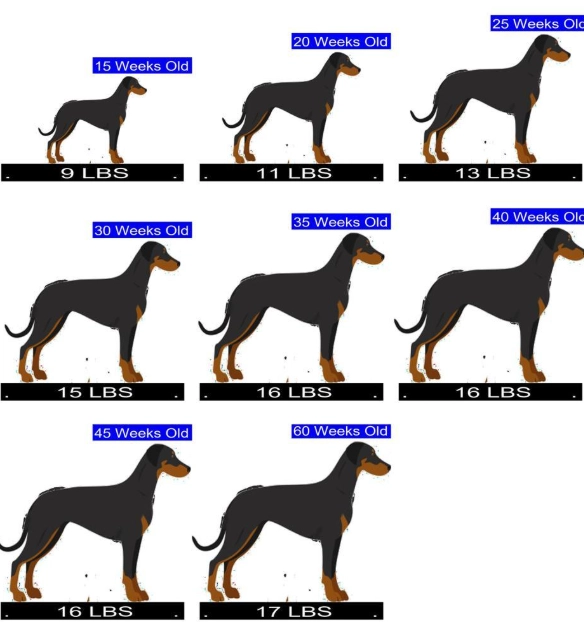
Beyond the Scale: What a Healthy Manchester Terrier Size Looks Like

From Puppy to Adult: The Manchester Terrier Growth Timeline
The First Year

Maturing into Their Frame
What Influences a Manchester Terrier's Final Size?

Size-Related Health Considerations You Should Know

How to Accurately Measure Your Manchester Terrier
Your Manchester Terrier Size Questions, Answered
The Bottom Line on Manchester Terrier Size
Quick Clarification: You might hear "English Toy Terrier" used interchangeably with the Toy Manchester. In the UK, that's actually the official name for the toy variety. In the US, they're both Manchester Terriers. It's a bit of a naming quirk, but they refer to the same small dog.
A Word on the Slender Build: New owners often panic that their Manchester is too skinny, especially during the gawky adolescent phase. They are meant to be lean. Comparing them to a bulkier terrier like a Jack Russell will make you worry unnecessarily. Trust the rib test, not your eyes compared to other breeds.
Patience is key. Don't judge the final product by the puppy model.
Pro Tip: When talking to a breeder, ask specifically: "What health screenings do you perform on your breeding dogs?" A good breeder will be transparent and happy to discuss OFA patella certifications, annual eye exams, and genetic testing.
Is a Manchester Terrier a small or medium dog?
This is the most frequent search. By any categorization, both varieties are small dogs. The Standard is on the larger end of "small," while the Toy is firmly in the "toy" or "tiny" category. You will never confuse a Manchester with a true medium breed like a Border Collie.
Can a Toy and Standard Manchester come from the same litter?
Yes, absolutely. If one parent is a Standard carrying the Toy gene, and the other is a Toy, the litter will typically be mixed. In litters where both parents are Standards carrying the Toy gene, you can also get a mix. This is why you sometimes see a range of Manchester Terrier sizes in puppy pictures.
My adult Manchester is over/under the weight standard. Is that bad?
First, consult your vet to rule out health issues. If the dog is healthy, energetic, and well-proportioned, being a pound or two outside the standard isn't a crisis, especially for pets. The standard is a guide for showing dogs. However, significant deviation (e.g., a 25-pound Standard or a 14-pound Toy) usually means the dog is overweight or there's mixed ancestry far back. The health implications of being overweight are real, so that's the situation to actively manage.
Which size is better for apartments/families/active owners?
Toy Manchester Terrier size makes them ideal for apartments due to minimal space needs, but they still require mental stimulation. Standards also do fine in apartments if exercised adequately. For families with very young children, the sturdier Standard may be a slightly better choice simply because they're less fragile. For highly active owners who run or hike, the Standard's endurance often makes it a more natural fit, but a fit Toy can surprise you.
Comment